Print or E-reader: Choose by the Reading Moment
Print or e-reader choices depend on the moment: match books and screens to your setting, attention, and reading habits for a more comfortable session.
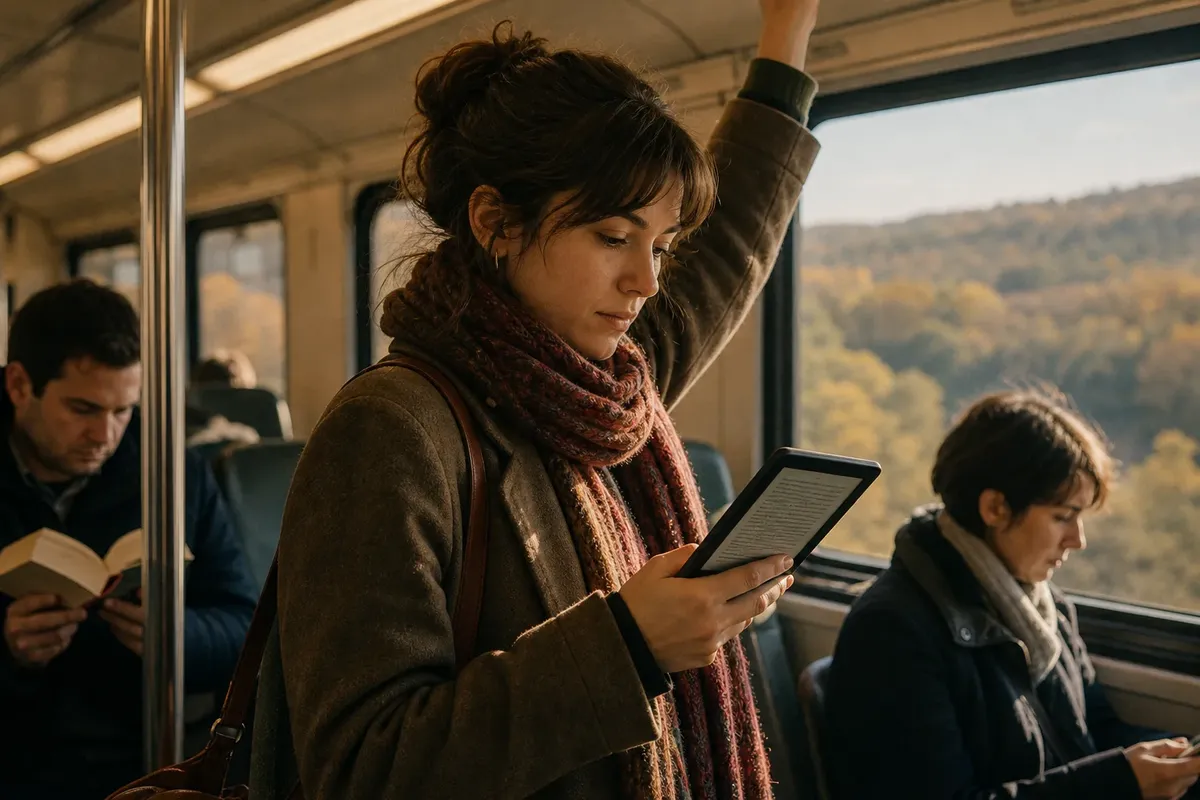
Print or e-reader is a useful question to ask while packing for a train, settling into bed, or trying to read beside a sleeping child. The better format depends less on which one is superior than on what the moment asks of you: a steady place to focus, a book that travels lightly, a page you can mark, or a screen that stays legible in dim light.
When does print make it easier to focus?
A printed book gives a reading session a clear boundary. It has a beginning and an end in your hands, and there are no incoming messages or open browser tabs on its page. That physical limit can make it easier to stay with a novel, a difficult essay, or writing that asks you to hold several ideas in mind.
The advantage is not automatic. A paperback can be interrupted by a conversation just as easily as an e-reader can be interrupted by a notification. But if your phone tends to pull you toward other tasks, a print book offers a quieter object to return to.
Print also gives reading a sense of location. You may remember that a scene appeared near the bottom of a left-hand page, or that an argument came before a chapter break. Those visual and tactile cues can help when you want to revisit a passage without searching.
When is an e-reader more convenient?
An e-reader suits the gaps between places: a waiting room, a train seat, a lunch break, or a bag with little space left. Several books can travel on one device, so you can move from a novel to a short essay without carrying both. A built-in light can also make text readable when the room is dim and you do not want to switch on a lamp.
That convenience comes with a different kind of attention. A device may invite you to check the time, adjust settings, or browse beyond the book. If those small interruptions matter, put the e-reader in airplane mode when you do not need a connection, or choose a dedicated reader rather than a tablet with social and work apps.
Consider the screen itself, too. E-ink readers have a page-like display and are designed for reading, while tablets use bright, versatile screens that can show color and illustrations. The right choice depends on what you read and how the screen feels to your eyes; if possible, try a few pages before committing to a device.
How do light and posture affect the choice?
Light changes the decision. Print can be comfortable by a window or under a focused reading lamp, but a dim room may make small type tiring. Many e-readers let you change type size and add front lighting, which can help when the available light is uneven.
Posture matters just as much. A large hardback may be awkward to hold overhead or on a crowded bus, while a small paperback can be easier to balance in one hand. An e-reader is often light and easy to grip, though its smooth surface can be slippery, and a tablet may feel tiring to hold during a long session.
Think about the moment rather than an ideal reading setup. If you usually read for a few minutes while standing or shifting seats, a compact device or a slim paperback may be more practical than a heavy volume. If you settle into a chair with both hands free, size and weight may matter less than the page design.
When does a printed page matter more?
Books with maps, diagrams, photographs, or carefully arranged pages often benefit from print. A spread lets you see two facing pages at once, and the physical dimensions preserve the intended scale of an illustration. That can make a cookbook, art book, poetry collection, or book of maps easier to browse.
Digital editions vary. Some preserve the printed page as a fixed layout; others reflow text when you change the font size. Reflow can improve comfort for ordinary prose, but it may separate a caption from its image or rearrange a table. Check the sample or edition description if the layout is central to the book.
For annotation, the choice is more personal. Pencil marks and sticky tabs are quick to place and easy to see at a glance. E-readers may offer highlights, notes, and search, which can help you retrieve a phrase later, but the tools and export options differ by device and book service.
Which format fits common reading situations?
Is print better for focused reading?
Print can help if a separate, screen-free object makes it easier to ignore other tasks. It cannot prevent interruption, but it removes the device features that commonly compete for attention.
Is an e-reader easier to use before sleep?
It can be convenient because the screen has adjustable lighting and the device can be used without a separate lamp. If light or screen use affects your sleep, choose a comfortable setting or switch to print and a suitable reading light.
Which format works better for travel?
An e-reader can carry multiple books in a small space and may be convenient during a long journey. A paperback does not depend on battery charge and can be easier to lend or pass along, so the trip and your reading habits decide the fit.
Can I switch between formats for the same book?
Yes, if both editions are available and the cost and access arrangements suit you. A digital copy can serve on the commute while a print copy stays at home, though notes and page locations may not carry between them.
What practical friction can each format remove?
Small annoyances often decide whether a reading session happens. A heavy bag may make a physical book a poor travel companion; a dead battery or forgotten charging cable may make a device inconvenient. If you keep abandoning one format for a particular reason, treat that as useful information rather than a failure of discipline.
Imagine you have a paperback novel at home and a daily train ride where you often stand. You choose the paperback for longer evening sessions and an e-reader for the commute, where the compact device is easier to hold. The expected observable result is that you can read during the standing ride without juggling a larger book, while the paperback remains available for a settled session.
Access can matter as much as comfort. Libraries may offer print loans, e-books, or both, with different availability and return rules. If you want to share a title, lend a physical copy; if you need adjustable text or searchable passages, check the digital edition’s features before choosing.
What should you check before choosing print or e-reader?
Use the conditions of the next reading session to make a practical choice. For each observation, follow the matching decision; if the first option does not fit, use the alternative.
- Observe whether you will be standing or changing seats; if you will, choose a compact e-reader or slim paperback, and otherwise consider a larger print edition if its layout helps.
- Observe whether your bag has room for a book; if it does not, choose an e-reader, and otherwise take print if you prefer a screen-free page.
- Observe whether the room has enough light for the book’s type; if it does not, use an e-reader with adjustable front lighting, or add a suitable lamp if you prefer print.
- Observe whether the book depends on maps, images, or facing-page comparisons; if it does, choose a print edition or inspect a fixed-layout digital sample, and otherwise consider reflowable text.
- Observe whether you want handwritten marks or searchable notes; if you want handwritten marks, choose print with a pencil or tabs, and otherwise check that the e-reader supports the note tools you need.
- Observe whether the device is charged and available; if it is not, choose a print copy, and otherwise use the e-reader if portability matters more for this session.
- Observe whether you expect to lend or pass the book along; if you do, choose print, and otherwise consider a digital edition if adjustable text or search matters more.
There is no need to settle the print-or-e-reader question once and for all. Let the moment make the choice: a paperback for a chair by the window, an e-reader for a moving train, or whichever format leaves enough attention for the book itself. The useful comparison is between the reading session you want and the one each format makes easier to begin.
Keep reading

The Myth of the Perfect Reading Streak
The perfect reading streak can make a pause feel like failure. Choose a modest return cue…