When the Page Became a Mass-Made Thing
How repeatable printed pages changed access to books, making shared texts easier to produce, compare, teach from, and carry beyond a single institution.
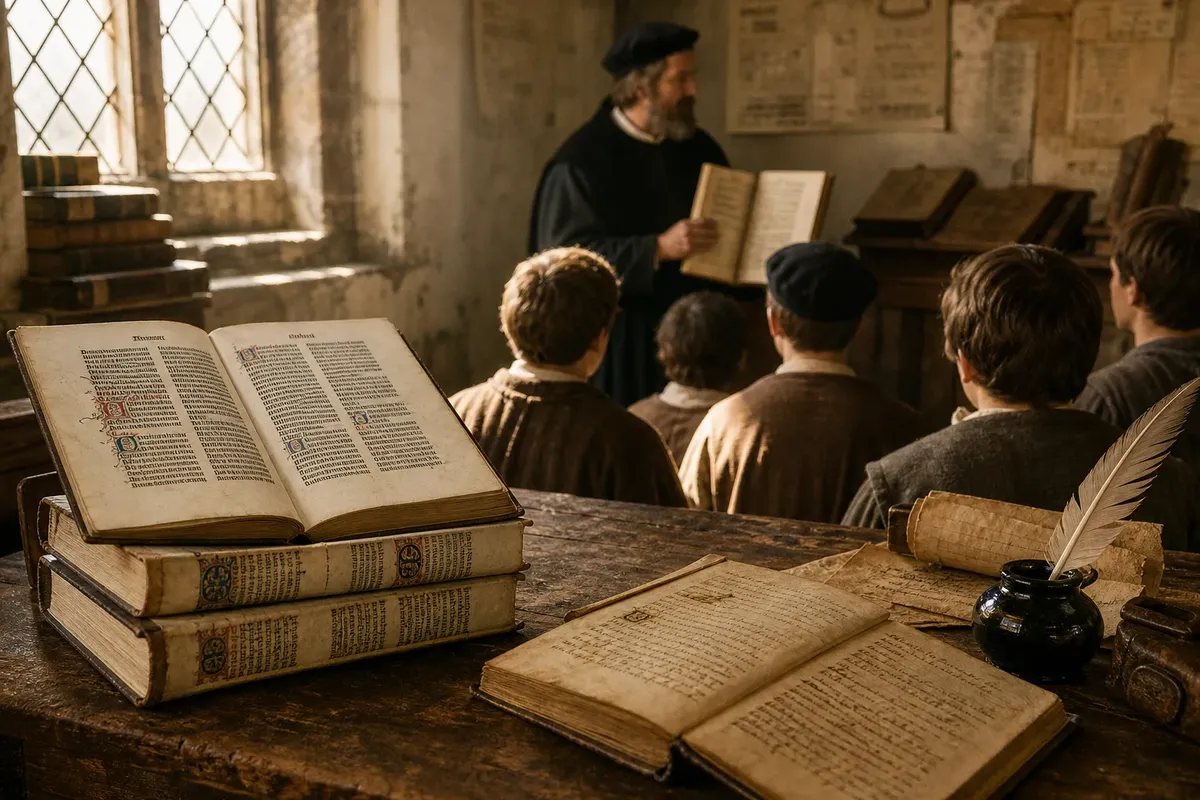
Imagine a small school in fifteenth-century Europe with one handwritten Latin grammar and a room of pupils waiting to use it. The master reads a passage aloud; a few learners copy what they can onto scraps. Now imagine that school receiving several copies of the same text, printed from reusable type. The change is not simply that books become more plentiful. A text that once depended on a particular copyist, patron, or library can begin to travel in a repeatable form.
This invented situation offers a way to see what changed when the page became a mass-made thing. Printing did not make books instantly cheap or put them within reach of everyone. It did alter the conditions of making, circulating, and using texts: the same words could be reproduced in batches, compared across copies, and brought into settings where a unique manuscript had been difficult to share.
What did the school have before printing?
Before European movable-type printing took hold, books were made by hand. A scribe copied words onto prepared parchment or, increasingly in many places, paper. The work demanded time and materials, and the finished volume was a particular object with its own handwriting, layout, corrections, and signs of use.
That did not mean every book was rare in the same way, or that written culture stood still. Monasteries, universities, courts, and urban workshops supported different kinds of copying. Manuscripts could be commissioned, borrowed, taught from, and circulated; their production was organized in more than one way. But making another copy generally required another act of transcription.
In the imagined school, one grammar might serve as a model for lessons and as the source for pupils’ notes. If a copyist produced a second version, its wording and arrangement could differ. A missing line, a spelling choice, or a teacher’s annotation might become part of that particular copy’s history. The school did not possess an abstract text separated from its physical witness; it had a specific book through which the text was encountered.
What did movable type change?
In Europe, the spread of printing with movable metal type in the fifteenth century made it possible to arrange reusable characters into pages, print a run, then redistribute the type for another setting. A press did not eliminate skilled labor. Printers, compositors, correctors, paper suppliers, binders, and sellers all contributed. The important shift was that a page’s arrangement could serve as a pattern for producing multiple impressions.
That repeatability changed the economics and organization of copying. Instead of transcribing a whole book each time, a print shop could prepare a text for a batch. The work still involved expense and risk: paper had to be acquired, type set, presses operated, and unsold copies stored or moved. Yet the effort of producing the next copy was no longer identical to the effort of creating the first handwritten one.
Printed books were not automatically uniform. Compositors could introduce errors, corrections could be made during a print run, and different editions could vary. Even copies from one edition might carry different marks if a press issue was corrected while printing continued. Still, readers could increasingly encounter copies built from a shared setting rather than from separate acts of handwriting.
How might the school’s day have changed?
Suppose, in this invented case, a printer near the school produces a modest run of the grammar. The headmaster acquires several copies through a bookseller, and the school assigns them to small groups rather than keeping one volume at the front of the room. Pupils can follow the same printed passage, mark difficult terms, and return to a shared page arrangement during a lesson.
The observable result would not be universal literacy or an end to scarcity. It would be a different classroom routine: fewer learners waiting for the single book, more students able to consult the same sequence of lessons, and a teacher able to direct attention to a passage that appears in each copy. If one copy is damaged, the others still preserve the printed text in that edition.
That last point is easy to overlook. A manuscript can be copied again, but a printed edition distributes a text across multiple objects made from a common setting. Loss of one volume need not mean the loss of that particular version, provided other copies survive. The book’s vulnerability shifts from the fate of one object toward the broader survival of an edition and its copies.
Did more copies mean broader access?
More copies created a possibility, not an equal distribution. Price, literacy, language, geography, censorship, and institutional control continued to shape who could read. A printed Latin textbook might reach schools serving clerics or scholars while offering little immediate benefit to someone who could not read Latin or afford a book.
Access also depended on routes and habits of use. Booksellers, fairs, schools, libraries, religious houses, and private networks moved printed matter from workshop to reader. A person might hear a text read aloud before owning a copy, or consult a book through a teacher or institution. Print could widen the circle of contact without making individual ownership the only measure of access.
Over time, printers issued works in languages and formats suited to different audiences. Religious texts, practical manuals, literary works, and educational books did not all find the same readers or follow the same commercial path. The central change was that producers could plan for multiple readers at once, rather than treating each new copy chiefly as a separate copying project.
What did readers gain from repeatable pages?
A shared printed page made comparison easier. Teachers could direct a class to the same passage; scholars could discuss a text with greater confidence that others had a related edition before them. Readers could also notice differences between editions, though they still had to account for errors, revisions, and the survival of older handwritten copies.
Repeatability helped stabilize some texts while making variation more visible. A printer’s edition could establish a recognizable arrangement, but a later edition might alter wording, add commentary, or correct perceived mistakes. Printers and editors made choices about what to include and how to present it. The printed page therefore did not merely preserve a text; it gave that text a particular form and a route to new readers.
For the school in our invented case, pupils might begin to recognize not only the grammar’s words but also its sequence and page layout. A lesson could refer to a passage in terms that other copies made useful. That shared reference is a quiet but significant consequence: texts become easier to teach, debate, and revise when people can consult related versions.
Why do historians still care about the particular copy?
Mass production did not turn books into interchangeable containers. A copy’s binding, annotations, ownership marks, stains, missing leaves, and repairs can reveal how it was handled and where it traveled. Two books from one edition may share their printed text but record different lives after leaving the press.
The distinction matters in libraries and archives. Cataloguers identify editions and compare copies; conservators attend to the physical condition of each object; historians may ask who owned a volume, which passages were marked, or how a text was used. The edition helps explain the repeatable page, while the individual copy preserves evidence of lived contact with print.
In the imagined school, one pupil might add a gloss in the margin, while another copy remains clean until a later owner writes a name on its flyleaf. The printed text connects the books; their marks separate their histories. Looking at both levels prevents a simple story in which printing erases the character of the handmade object.
What questions help explain the shift?
Did printing replace handwritten books?
No. Manuscripts continued to be made and used after printing spread, and handwriting remained important for records, correspondence, drafts, and other purposes. Print altered the conditions of book production without ending the need for writing by hand.
Were the earliest printed books cheap?
Not necessarily. Printing could make multiple copies from one setting, but paper, labor, equipment, distribution, and the size of a book all affected its cost. A larger supply did not mean every household could purchase a volume.
Did every printed copy contain exactly the same text?
No. Errors, corrections made during a run, editorial decisions, and later editions produced variation. Copies from one edition share a production history, but a careful reader or cataloguer may still find differences.
What made print useful to schools?
Related copies could give teachers and pupils a common sequence of passages and lessons. Their usefulness depended on the language, subject, price, and school’s resources, rather than on printing alone.
What does the school’s story leave us with?
The imagined classroom shows a change in practical terms: a single handwritten grammar becomes a small group of related books, and a lesson can be organized around pages shared by more than one reader. That is a modest scene, but it captures the larger shift from copying each book by hand to producing editions in multiples.
When the page became a mass-made thing, access expanded unevenly, not automatically. Its deeper consequence was the creation of repeatable points of contact: readers could meet a text in related copies, carry it between institutions, and build discussion around a page that no longer belonged to just one manuscript. The next time you open an old printed volume, look for both kinds of history—the edition’s common design and the individual copy’s marks of passage.
Keep reading

What a Book’s Spine Does Before You Open It
Learn what a book’s spine does, how binding and spine lettering differ, and how to choose…

Print or E-reader: Choose by the Reading Moment
Print or e-reader choices depend on the moment: match books and screens to your setting, attention,…