One Day, Three Journal Forms: List, Letter, and Snapshot
One day, three journal forms help you keep a day’s details, a note to your future self and one vivid moment, each in a form suited to revisiting.
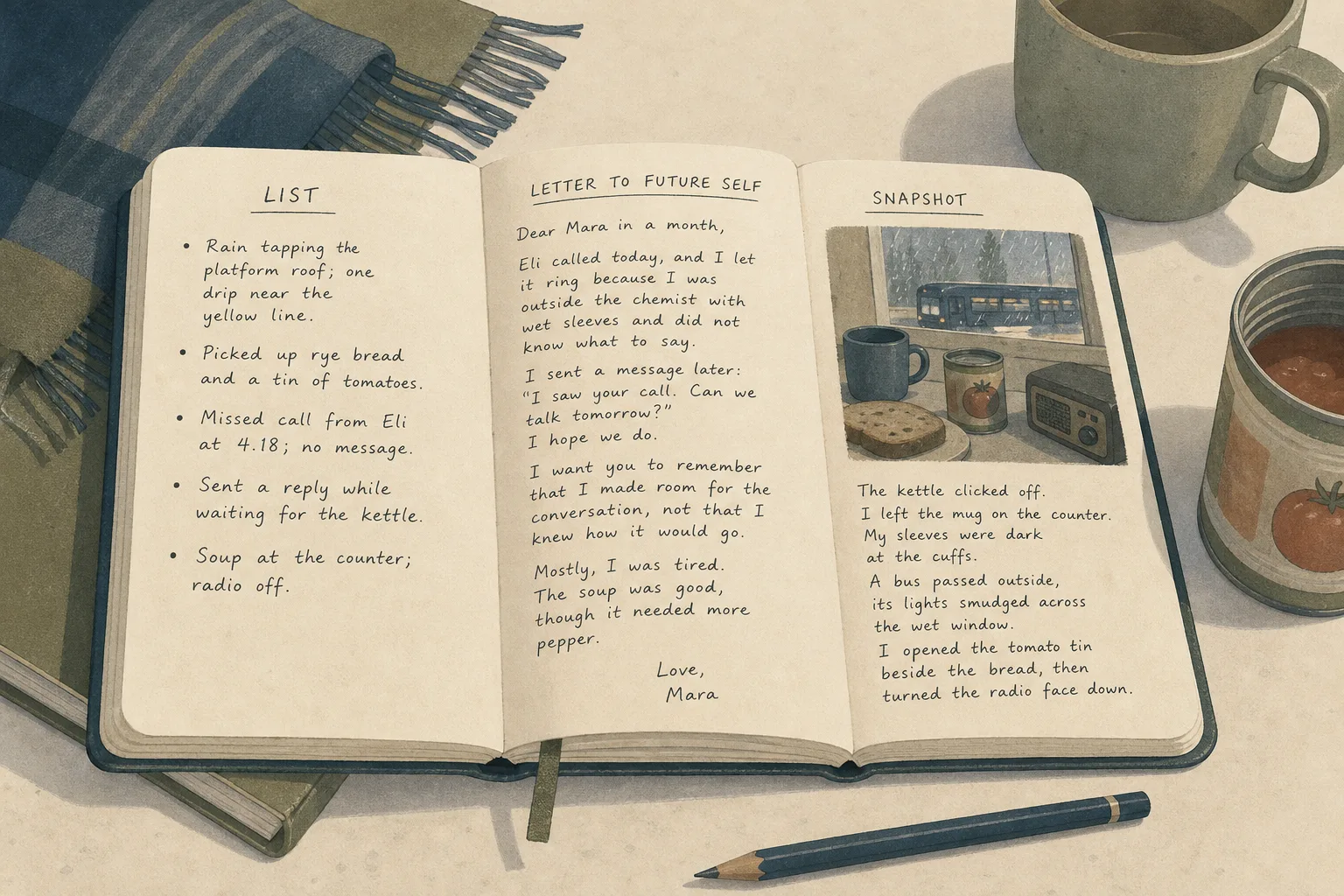
Which journal form will help you return to an ordinary day later? One day, three journal forms—a list, a letter to your future self and a snapshot—can preserve its small particulars without asking them to add up to a story. The choice is less about how much happened than what you want the page to hold.
Imagine that Mara, an invented person, has a Tuesday with a damp walk to the station, a missed call from her brother Eli and soup at the kitchen counter. She has a pocket notebook, a pencil and a few minutes before bed. She writes the day three ways, giving each form a different job: a quick index, a note addressed forward in time and a close view of one moment.
What can a journal list help you find again?
A list is useful when you want to make details easy to scan. It does not need a plot or a ranking. Mara writes under the heading Tuesday, on the way home:
- Rain tapping the platform roof; one drip near the yellow line.
- Picked up rye bread and a tin of tomatoes.
- Missed call from Eli at 4.18; no message.
- Sent a reply while waiting for the kettle.
- Soup at the counter; radio off.
On a later reread, the heading and separate lines make it easy to locate a detail without searching through a paragraph. The list is also a useful form for recurring interests: books borrowed, meals cooked, a phrase heard on the bus or the things carried on a walk.
Its plainness has a limit. The lines do not tell Mara why she turned off the radio or whether the missed call mattered more than dinner. That is a reasonable trade: the list keeps the day’s index compact, but leaves room for other forms to hold context and atmosphere.
What belongs in a letter to your future self?
A letter makes the present moment addressable. Mara writes to a future version of herself, not to deliver a lesson but to retain a thought that may otherwise blur into what happened next.
Dear Mara in a month,
Eli called today, and I let it ring because I was outside the chemist with wet sleeves and did not know what to say. I sent a message later: “I saw your call. Can we talk tomorrow?” I hope we do. I want you to remember that I made room for the conversation, not that I knew how it would go.
Mostly, I was tired. The soup was good, though it needed more pepper.
Love, Mara
The direct address gives the entry a listener. It can preserve a hope, a question or a decision as it sounded at the time, rather than turning it into general advice. Mara’s note about the soup also keeps the letter attached to an actual evening, rather than allowing the call to occupy every line.
Letters can expand into arguments with an imagined audience. If Mara spends the whole entry explaining why she waited, the form has become heavier than the moment needs. A few candid lines may be enough.
How does a journal snapshot differ from a full account?
A snapshot stays with one place and a brief stretch of time. Mara chooses the kitchen after her walk home:
The kettle clicked off. I left the mug on the counter. My sleeves were dark at the cuffs. A bus passed outside, its lights smudged across the wet window. I opened the tomato tin beside the bread, then turned the radio face down.
The entry gives a future reader a small arrangement to return to: damp cuffs, reflected lights, tin, bread, radio. It need not explain the whole day. Like a photograph kept in a drawer, it offers a particular view rather than a complete account.
That narrow focus is also the trade-off. A snapshot may hold the kitchen’s texture but omit the message Mara sent and the question she hopes to discuss with Eli. If those are the details she wants to retrieve, the list or letter will serve better.
Which journal form suits the detail you want to keep?
When is a journal list the better choice?
Use a list when you want a quick index of separate details, tasks or recurring interests. Its short lines are easy to scan later, though they may not explain why a detail mattered.
What should you write in a letter to your future self?
Write a thought that may change with time: a hope, hesitation, question or decision. Address the future reader plainly, and do not make the letter supply an answer you do not yet have.
How brief should a journal snapshot be?
Keep it to one place and a small stretch of time, using a few objects, sounds or actions. If you need to recount several events in sequence, a list or longer entry will be easier to follow.
Can you use all three forms for the same day?
Yes, if each entry does a separate job: the list indexes details, the letter preserves a thought, and the snapshot holds one scene. You can also use just one form when that is enough.
How can you choose a form without adding a journalling chore?
Start with what you want to find on a future reread. If you want to locate several details, write a list. If you want to preserve a hope or question in your present voice, write a letter. If one place or moment is what you can still picture, write a snapshot.
Say you have a blank page, a pencil and three details from an invented Tuesday: a library book due back, a message from a cousin asking to meet, and the smell of wet coats on the bus. First, write those three items as separate lines. The observable result is a compact index; if you mainly want to remember the proposed meeting, turn that line into a letter noting what you want to ask, but if you mainly want to revisit the bus ride, use the coat smell as the start of a snapshot. If both matter, add the second form only if you still have room and interest. The trade-off is clear: more forms preserve different kinds of detail, but also take more of the evening.
For another day, one line may be sufficient. A journal is not improved by completing a set of forms. One day, three journal forms are options for different kinds of attention, not a requirement to make an ordinary Tuesday perform.
When you return to an old page, read it as a record made with the knowledge available then. Add a dated note if your understanding has changed; the earlier entry can remain intact, like a bookmark left where you stopped.