What to Keep When a Memory Comes Back in Pieces
Journal a memory in fragments with a simple page layout that preserves the original cue, loose details and later additions for clearer, easier revisiting.
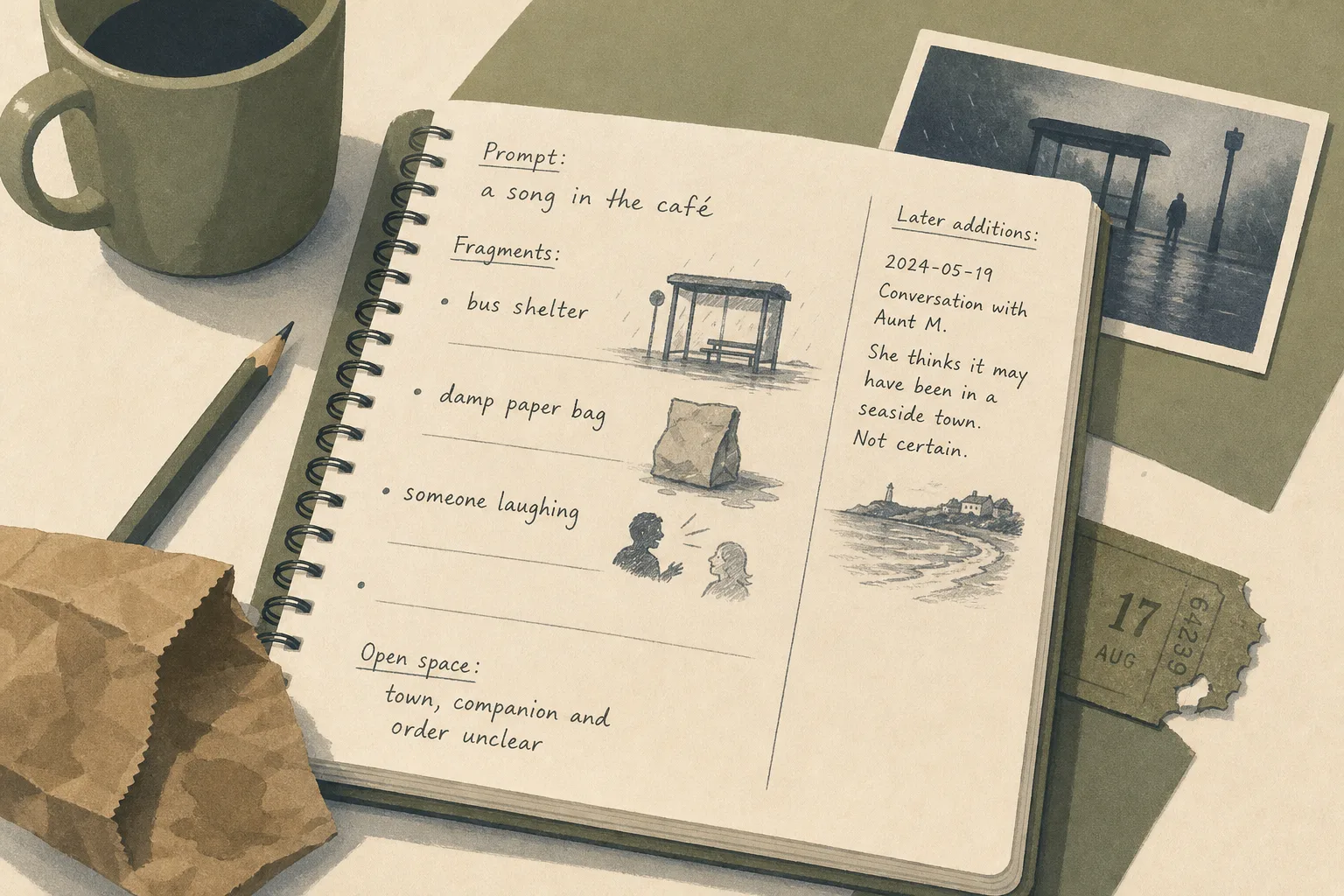
A song in a café brings back a bus shelter, a damp paper bag and someone laughing. You cannot place the town or say what happened next. To journal a memory in fragments, give the pieces room on the page instead of turning them into a scene.
The aim is not to reconstruct a complete account. It is to make a useful page that lets you return to the fragments without losing the way they first arrived.
What belongs on a fragment page?
Start with the prompt, if you know it: a song, a smell, an object or a conversation. Then give each fragment its own line. Keep sensory details close to the words that brought them to mind, and leave a blank line where the sequence is missing.
A small notebook works well, as does a dated note in a phone. If you use paper, a pencil lets you add a margin note without making the page look like a legal exhibit. A plain analogy helps: treat the fragments like loose buttons in a tin, not pieces of a puzzle whose picture you are obliged to complete.
Use a compact layout:
- Prompt: What brought the memory to mind, if anything?
- Fragments: One image, sound, phrase or sensation per line.
- Open space: A blank line or a note such as “next part unclear”.
- Later additions: A separate dated note if a conversation, photograph or document adds something.
How can I keep the page useful without making it a report?
Write in the form that fits the fragment. A few words, a rough sketch, a copied phrase or a small object such as a ticket stub may say more than a polished paragraph. If you include a photograph or paper scrap, note what it is; the object can prompt writing, but it does not fill in the parts you cannot recall.
Leave room for the page to remain unfinished. You might write “wet sleeve”, “yellow light” and “someone laughing”, then stop. The useful choice is to keep those details together on the page while leaving their relationship open.
What should I check before adding a detail?
- Prompt: Check whether you know what sparked the entry. If you do, name it; if you do not, write “prompt unclear” rather than supplying one.
- Form: Check whether the new detail is a word, image, sound or sensation. If it stands on its own, give it a separate line; if it depends on a connection you cannot place, leave that connection unstated.
- Sequence: Check whether you can actually place one fragment before another. If you can, write the order plainly; if not, keep separate lines and leave a gap.
- Source: Check whether the detail came to mind during the original writing or after a later prompt. If you know the source, name it in a new note; if you do not, mark the source unclear and keep it out of the original lines.
- Material: Check whether a keepsake or image has a clear relation to the entry. If you know its connection, label it; if not, store it separately rather than treating it as evidence for a scene.
- Comfort: Check how you feel while writing. If you are comfortable continuing, add only what comes readily; if the writing feels difficult to manage, close the notebook and return only if you choose.
How do I make a fragment entry in practice?
- Write the prompt. Name the song, object or other cue if you know it. If its name escapes you, use “prompt unclear”.
- Give each piece a line. Record an image, sound, phrase or sensation without joining it to another fragment. If a detail will not come, leave the line empty.
- Mark missing links. Use a short note such as “place unclear” or “order unknown”. If a connection is only a possibility, leave it out of the main fragments.
- Leave room for later material. Add a margin or a fresh dated note for anything that comes from another source. If no new information arrives, leave the space blank.
- Stop when the fragments stop. Close the entry when you have nothing more to add. If the page feels unfinished, let it be unfinished.
Say you hear a song and begin with three invented starting fragments: “bus shelter”, “damp paper bag” and “someone laughing”. You do not know the town, companion or order. Write the song in the prompt line, put each fragment on its own line, then add “town, companion and order unclear”. Later, imagine a relative says the scene may have been in a seaside town. Add a new note naming that conversation; leave the original lines as they are. The resulting page holds the initial pieces and the later suggestion separately, without deciding that either supplies a complete scene.
What can I ask when I return to the page?
Which fragment do I want to spend time with?
Choose a line that still catches your attention and write a few words beside it, or leave it as it is. There is no need to turn every fragment into a longer entry.
Would a sketch or object help me describe it?
A quick drawing, colour swatch or named keepsake can give the page another form. Label what you add so a future reader can tell it is a later addition.
What can stay blank?
Keep any missing place, order or transition open if it does not come to mind. A blank is a record of what the page does not contain, not an invitation to improvise.
Do I want to continue today?
Notice whether writing feels manageable. If it does, add a line or two; if it does not, close the notebook and choose another activity.
What if the entry brings up a strong feeling?
You can write a brief note about your present reaction, such as “I feel uneasy writing this today”, or stop without explaining why. Journalling does not require a complete memory or a finished account.
If the material feels difficult to manage, pause and speak with someone you trust. A qualified mental health professional can discuss additional support if you want it.
For a memory entry, a useful page need not tell a smooth story. Keep the original prompt and fragments legible, and make later additions easy to spot. When you journal a memory in fragments, the blank space can do its quiet job: it stops the page from pretending to know more than it does.