The First Page Does Not Need a Grand Opening
Begin a journal with a small observation, question or scrap, and make a first entry that feels manageable rather than polished or ceremonial.
To begin a journal, you do not need a striking story or a promise to write every day. Start with one thing you can point to: the kettle’s click, a damp sleeve, or the note you keep forgetting to send. A first entry can simply preserve what is already in front of you.
The useful question is not how to make the opening impressive, but what is worth keeping from this particular moment. Treat the page less like a stage and more like a kitchen drawer: a place for things you may want to find again, even if they do not match.
What is worth putting on the first page?
Choose a detail, fragment or question that has some grip on your attention. It can be modest and incomplete. Specificity helps: “the cold rim of the mug” gives the future reader more to recognise than “a normal morning”.
- A small observation: Record a sound, texture, smell or visible detail, then decide whether it matters enough to keep as a memory or simply as a record of the moment.
- A loose-end list: Name what is occupying your mind without ranking it; if the list helps you see the separate threads, leave it as a list, and if it feels like more administration, choose one item and describe it instead.
- A question: Write something you genuinely want to understand; if it remains useful without an answer, leave it open, and if it feels too abstract, connect it to a particular conversation or event.
- A found fragment: Copy a line from a note, add a ticket or sketch a shape; if the fragment brings back a scene, add a sentence about where it came from, and if it does not, let it stand alone.
- A date or place: Add whichever context will help you identify the entry later; if the entry would still make sense without it, omit the label rather than decorate the page by habit.
- A change in attention: Note what has become noticeable since earlier in the day; if you can name the contrast, record both details, and if you cannot, keep only the observation you have.
These are openings, not requirements. A page can contain handwriting, a scrap of paper, a quick pencil mark or nothing beyond a single sentence.
How can a journal hold more than a daily account?
A journal does not have to report the day from beginning to end. It can collect evidence of what caught your attention: a phrase overheard on the bus, a map drawn from memory, or a note about why a familiar room felt different. Keeping these fragments beside ordinary entries lets you revisit them without pretending they form a complete record.
Try giving a fragment just enough context to remain legible later. Name where it came from, what was happening around it, or why you paused. You need not explain its importance. The explanation may change, and the fragment can remain useful without a tidy lesson attached.
What if you have nothing to write?
What can I write when my mind is blank?
Describe what is happening in plain present tense: “I am by the window; the radiator is ticking.” If another detail arrives, add it; if not, the sentence is already a record. Begin with something observable rather than trying to manufacture an insight.
Do I need to write every day?
No. Irregular entries are still entries, and a gap needs no explanation. Write when something seems worth keeping, or return when you next have a useful reason to open the notebook.
What if my first entry sounds awkward?
Leave it as it is. It records a moment, not a submission for approval. If you want to write again, start a new entry rather than making the first one carry the burden of becoming better.
Can I start with a question instead of a story?
Yes. A question can preserve uncertainty without forcing an answer. Keep it near something real, such as “Why did that conversation stay with me?” rather than asking the page to produce a grand theory.
How should you choose what to keep?
Before adding a detail, ask what you might want to recover later: the sound itself, the place, the feeling it brought up, or the fact that you noticed it at all. There is no need to decide whether a moment is important in some lasting sense. The smaller decision is whether it deserves space on this page.
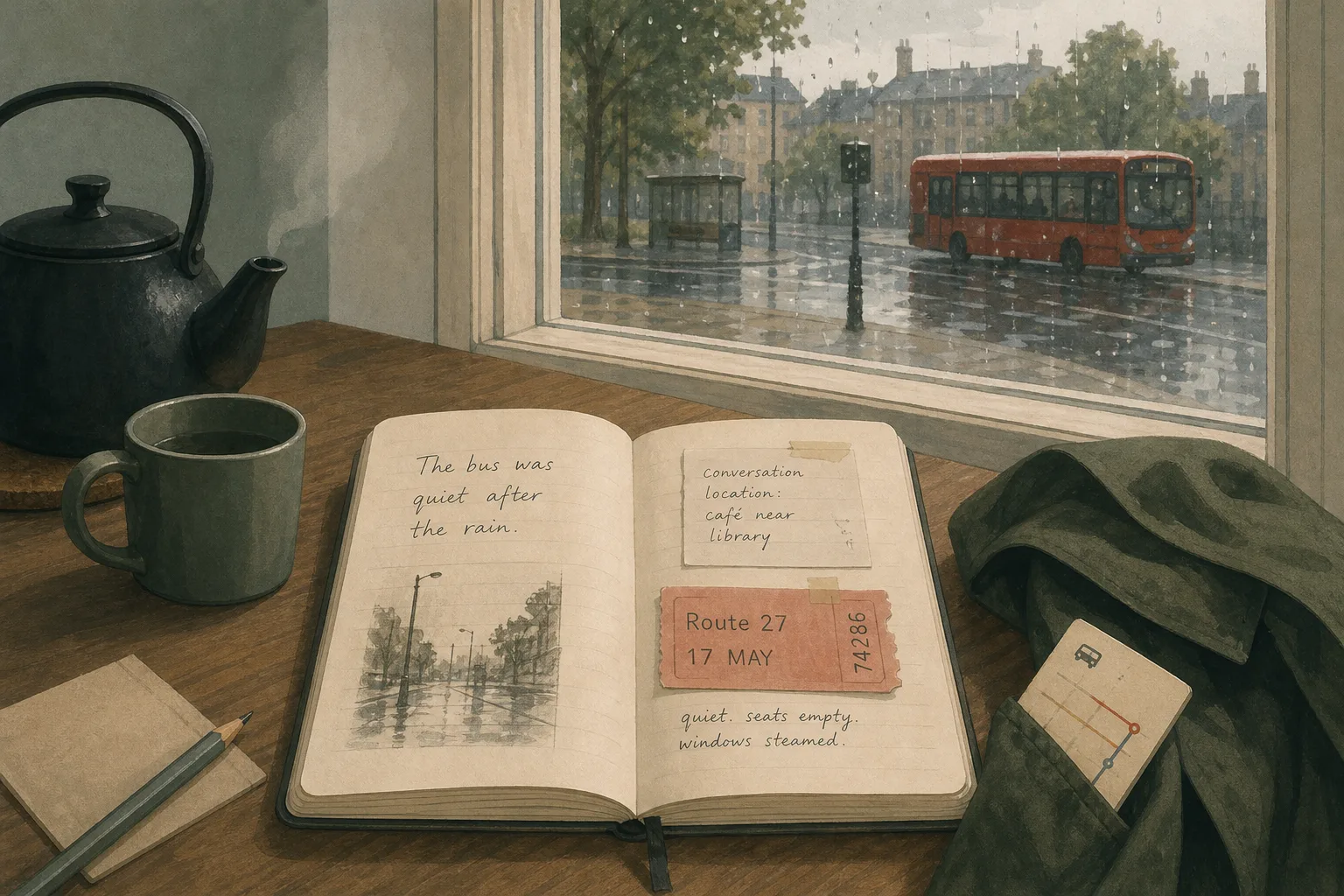
Imagine you have a plain notebook on the kitchen table, a bus ticket in your coat pocket and a note about a conversation you cannot quite place. You copy the ticket’s route and date into the notebook, then add the starting observation, “The bus was quiet after the rain.” Next, you write the conversation’s location beside the note, but leave its meaning unresolved. The resulting page contains three identifiable fragments; if you later recognise why the conversation stayed with you, you can add that thought, while the ticket and observation remain useful records on their own.
If writing starts to feel like sorting your life into important and unimportant parts, reduce the question. Keep the detail you can describe accurately and let the judgement wait. That makes a journal less like a verdict and more like a shelf with room for things whose use is not yet clear.
How can you return without turning it into a task?
Put the notebook where you are likely to notice it, or keep one pinned note in your phone for brief fragments. Use a familiar pause if it helps, but do not make a missed moment into a debt. If an entry feels forced, change its form: a question can become a list, and a list can shrink to one observation.
When you look back, choose a purpose. You might circle a phrase, add context to a fragment, or leave the pages alone. Revisiting is useful when it helps you notice something you want to carry forward; it does not need to become an inspection of how often you wrote.
To begin a journal, keep the first entry small enough to be honest and specific enough to recognise later. A single detail, properly placed, can be a more useful beginning than a page written to sound like one.